Investigación > Proyectos
TROIA (2024-2025)
TROphic Interactions of two echinoderms under ocean Acidification: insights from a natural laboratory (TROIA)
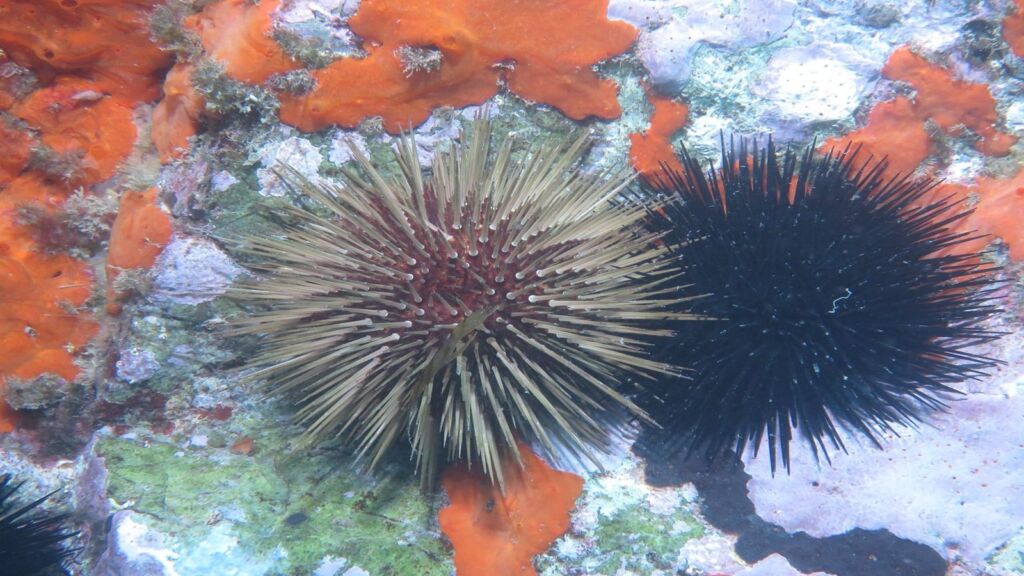
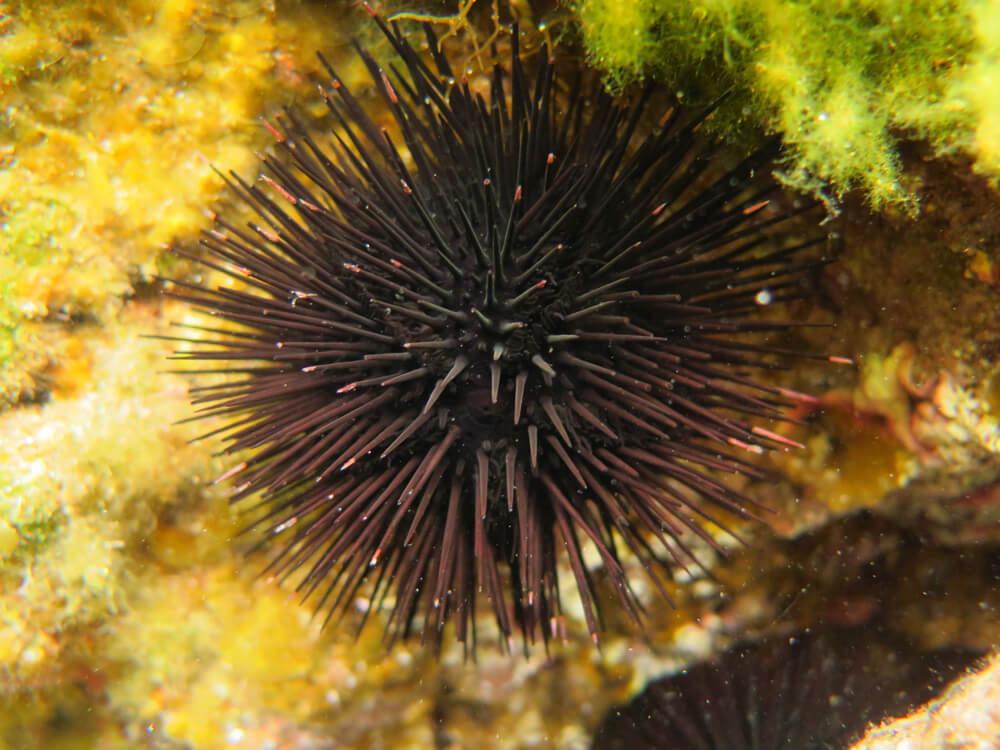
Objetivo: estudiar la posible modificación del comportamiento alimentario de los erizos de mar Paracentrotus lividus y Arbacia lixula, dos especies clave que conviven a lo largo del gradiente natural de pH del sistema de afloramientos de CO2 de Punta de Fuencaliente (La Palma), un análogo natural del océano acidificado del futuro.
En este sistema, la acidificación transforma las comunidades de algas e invertebrados, que pasan de ser heterogéneas y ricas en organismos calcáreos a estar dominadas por especies pequeñas, de crecimiento rápido y no calcificadoras. Ambos erizos han mostrado resiliencia a la acidificación y tienen preferencias de dieta algo distintas, pero se desconoce cómo cambiarán su alimentación y sus interacciones tróficas en condiciones futuras. TROIA combina dos aproximaciones complementarias, los isótopos estables (nivel trófico) y el metabarcoding de ADN (composición de la dieta), y valida este último como método no invasivo para estudiar la dieta de los erizos. Comprender estos efectos es clave para predecir cambios en la estructura de las comunidades marinas y sus efectos en cascada sobre el ecosistema.
Investigadoras principales: Vanessa Arranz Martínez y Sara González Delgado
Duración: 2024–2025
Financiación: Ayuda de Promoción de la Recerca del Institut de Recerca de la Biodiversitat (PR IRBio-UB 2024), Universitat de Barcelona.
English
Ocean acidification (OA) is a global problem caused by anthropogenic CO2 emissions, leading to decreased seawater pH and altered carbonate chemistry. These changes can negatively impact marine organisms, particularly calcifying species, and cause ecosystem shifts. CO2 vents provide natural laboratories to study the effects of OA on marine communities, such as the Punta de Fuencaliente system located in La Palma, Canary Islands, Spain. This site exhibits a strong acidification gradient, with significant changes in algal and invertebrate communities from heterogeneous, calcifying organisms to homogeneous, non-calcifying, and fast-growing species. Two abundant keystone sea urchin species found along this natural pH gradient are Paracentrotus lividus and Arbacia lixula. Both sea urchins have shown resilience to OA and slightly different diet preferences, but their feeding and trophic interactions in future acidified conditions remain largely unknown. TROIA project main objective is to investigate the potential modification of the feeding behavior of these two co-habitant species using a unique natural OA analog. Moreover, this project aims to validate a non-invasive DNA metabarcoding approach to study sea urchin diet composition and to compare two different and complementary approaches (stable isotopes and DNA metabarcoding) for inferring the trophic ecology of organisms. Understanding the effects of OA on key species trophic interactions is crucial for predicting future changes in marine community structure and the cascading effects on ecosystems.